
I recently wrote this blog post for SENSE (society for English-language professionals based in the Netherlands):
The art of public speaking: presenting in English with confidence
By Linda Jayne Turner, 12 May 2026
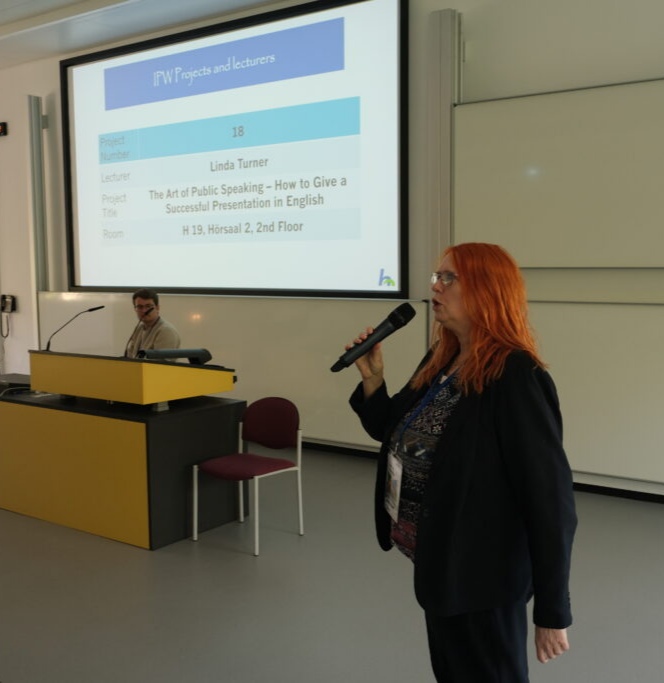
Most people are afraid of public speaking to some extent. Mark Twain once said: ‘There are only two types of speakers in the world: the nervous and liars.’ Many speakers admit to feeling nervous, even experienced ones, and a healthy dose of adrenalin due to slight anxiety can help you give your best performance. There are, however, also ways to keep your nerves in check and the more you practise public speaking, the easier it gets and the more confident you will become over time.
Knowing your audience
First things first, you need to know your audience so you can tailor your presentation to meet their needs, ideally even before you prepare your talk or panel discussion. Try to find out as much information about them as possible at an early stage, such as what they want to get out of the session, their subject knowledge and their level of English or whatever language you’re presenting in. It also helps to arrive early on the day and chat to a few people beforehand, so you get a feel for who is in your audience. If you are unable to speak to the audience in advance, you can also ask a few questions at the start of your session to gauge their level of knowledge and interests. If possible, attend the other sessions so you don’t duplicate what previous speakers have said, and you might even be able to relate your presentation to theirs. Engaging with the audience is key and it’s a two-way process, so please also do your best to be a good audience member when you’re attending someone else’s talk by listening actively, nodding and encouraging the speaker. When it’s your turn to speak, you’ll want this kind of support. As a member of the audience, perhaps you could also prepare some questions for the Q&A session while you are listening to a presentation.
Preparing and rehearsing
The importance of preparation and rehearsal cannot be stressed enough. Ensure your presentation has a clear purpose such as to inform, explain, persuade, or call to action. It is not advisable to write out a script and read it or learn it by heart but, rather, you should know your material well enough to speak naturally, with index cards as props if necessary. There are various ways to rehearse, either by recording yourself with video or audio and then reviewing to see where you could improve or, generally much better, rehearse in front of a trusted friend or colleague and get feedback from them. You should also time your presentation. Audiences love it when you finish on time and also, if you run over, you will either disrupt the event schedule or not have time to deliver the concluding parts of your presentation or answer any questions the audience may have. Anticipate possible questions for the Q&A at the end and prepare and practise your answers.
Set up early on the day and check in advance that all the technology works, including the computers. You should also practise using a microphone if you don’t use one regularly. This video shows how to hold a hand-held mic properly. Do a sound check in case any technical issues need to be solved before you begin speaking.
There are various techniques to help overcome last-minute nerves, such as doing breathing exercises before you begin. It is also a good idea to do a vocal warm-up to help you relax and avoid vocal fry (a creaky voice produced by low-frequency vibrations of the vocal cords). Here are some exercises you can do; a few minutes should suffice.
Projecting confidence
Experts claim that 93 percent of communication is non-verbal. It’s not just about what you say but how you say it and whether you appear nervous or confident and relaxed.
First, plan your outfit in advance. Dress smartly but comfortably; this can also make you feel more confident. And if you’re travelling to a conference, have a back-up outfit just in case of any mishaps along the way. Try to avoid fidgeting as this betrays nerves. You can, for instance, put up long hair so you won’t be tempted to keep pushing it back, and don’t wear jewellery that you tend to fiddle with. Keep your hands in a neutral position if not holding a microphone and only use them to gesture to help get your points across.
Use open body language. Don’t cross your arms or turn your back on the audience to read your slides or you will soon lose their attention. Eye contact is important. Look at the whole of the audience – not just to one side, although even experienced and effective speakers such as Margaret Thatcher have tended to look more to one side of the audience than the other (mostly towards the right). But you can focus on a handful of people in different sections of the audience. Don’t stand still in the middle of the stage for the entire presentation as this makes it difficult to connect with people on the far sides of the room. There are many videos on this subject such as 5 Body Language Tips for Your Next Speech by Brian Tracy.
General tips
For inspiration about public speaking styles, you can watch videos by renowned speakers such as Martin Luther King or Winston Churchill. Think about adopting some of the techniques that made their speeches effective, such as using rhetorical devices like repetition or the rule of three. A memorable example of this is Abraham Lincoln’s famous line from the Gettysburg Address: ‘government of the people, by the people, for the people’. There are also some ways to lighten the tone during the performance, for instance, with the use of humour, but be careful not to overdo it. Be authentic and remember that the audience doesn’t know exactly what you plan to say, so if you forget something, they most likely won’t notice.
PowerPoint
Many speakers use PowerPoint. Beware of the pitfalls: reading your PowerPoint presentation out to your audience is a sure-fire way to lose their attention, particularly if you turn your back on them to look at the slides behind you. PowerPoint should only be used as an aid – and wisely. Jean-Luc Doumont, author of ‘Trees, Maps, and Theorems’, gave an excellent keynote on the subject at a conference I attended: Effective slides: design, construction, and use. One piece of advice he shared was that if you don’t have time to prepare a good PowerPoint presentation, it’s better not to use one at all. A group of students I taught at Nordhausen University of Applied Sciences in Germany conveyed their messages in their final presentation about public speaking by acting them out rather than using PowerPoint, and this was highly effective. Watch a short clip here. Another sound piece of advice is to divide up the information on your slides to avoid having too much text on each one – and also take a printout of the slides with you in case the technology fails.
Speaking online
Particularly since the COVID-19 pandemic, many presentations have been online. It can be more challenging to engage with your audience if you’re speaking online but it helps if you ask them to switch their cameras on – and their microphones off – if possible so you can at least see them and gauge their reactions.
As with presenting in person, dress smartly but comfortably, and also bear in mind that blocks of colour tend to come across better on camera than patterns, and ensure your outfit doesn’t clash with or blend in with your background. A virtual background can be useful if the room you are presenting in is cluttered as that can be distracting for the audience. As with presenting in person, do a sound check beforehand and test out the lighting too. For an excellent short guide on presenting online, read How to Feel More Comfortable on Camera by Gillian Whitney (2023).
Other forms of public speaking
Another form of public speaking is participation in a panel discussion. This may be less stressful than giving a talk because the focus is not only on you. These sessions still need to be properly prepared but not completely scripted since the conversation needs to be natural. The same applies to podcasts.
Chairing a talk, moderating a panel or hosting a podcast are all forms of public speaking that require a particular set of skills. The moderator should support the speaker or help the panellists or guests shine. Their role is to ask questions and not dominate the discussion with their own opinions. A moderator or chair should agree with their speakers in advance on how they would like to be introduced, or whether they will introduce themselves. A podcast host should inform the guest in advance whether it will be audio only or audio-visual. As a guest, don’t be afraid to have some written reminders of things you want to say, for instance, if there is a particular point you want to make or resources or contact details you would like to share.
Conclusion
The more you practise, the more comfortable you will feel speaking and you might find you actually enjoy it or at least become less self-conscious. Make sure you know your audience and prepare as well as you can, including rehearsing, ideally with feedback from someone else. Practice makes perfect, or at least improves the performance, and it will also help with your confidence. Then, on the day, take some time to get into the zone and then relax and enjoy your presentation. Remember that you’ve been invited to speak because the organizers or host believe you have something important to say.
Linda Jayne Turner is an academic editor in the social sciences. She has been teaching at the International Project Week at Nordhausen University of Applied Sciences regularly since 2000, including courses on public speaking for students, lecturers and professors. In addition, she has taught public speaking at Charles University in Prague and at the International Business Week at the Business Management Faculty of Vilnius University of Applied Sciences. She also offers online coaching in public speaking.
 Blog post by: Linda Jayne Turner
Website: lindajayneturner.com
LinkedIn: lindajayneturner